Reflection
Through this project, we learned the importance of collaboration and working closely with other designers as a team. We developed a shared design system to ensure consistency and alignment across our work which helps all team members stay on the same page and move toward a common goal. Given the brief timeline of the project, we also learned to collaborate efficiently by dividing tasks based on individual strengths, communicating frequently, and making quick but thoughtful decisions. This time constraint challenged us to stay focused and flexible, which strengthened our ability to work as a team under pressure.
For future iterations, our team would like to conduct more user research to evaluate whether the prototype truly helps users learn more about local politics. Additionally, we hope to improve the interface by incorporating more interactive elements and exploring ways to make the content more engaging and accessible.
Solution
A Daily Quiz Game Exploring Local Politics in Seattle
After a total of 20 weeks our team completed our final prototype in time for the end of the school year and were able to share our work with our classmates and teaching team. View the major elements of our prototype below.
Users can navigate to the archive section of the app to play past uncompleted questions, review questions, or view their favorites.

Play or View Archived Questions
By completing a streak of 10 correct questions, users can unlock a coupon to a local Seattle coffee shop.

Unlock local Coffee Shop Coupons
Users are able to share their stats and questions in order to
compete with friends.
Share with Friends

The app prompts users with a daily question related to local
Seattle politics so that users can learn about and interact with politics in a digestible way.
Answer Questions

Iteration
Low-Fidelity Prototype
Created concept idea of the app
Created main screens that would be in the prototype
Did user testing to receive feedback on the concept

Mid-Fidelity Prototype
Based on usability testing:
Developed colors, style, and reward system
Changed map screen to be a pathway of levels
Expanded organization of archive pages

High-Fidelity Prototype
Based on expert critique:
Improved the layout of each screen to make users feel less overwhelming by taking out the streak bar and separate each element to it own section
Improved archive page to be more clear for the current date and the dates missing on the quiz
Made the share section more clear for what users could share with their contacts

Ideation
Concept Sketches
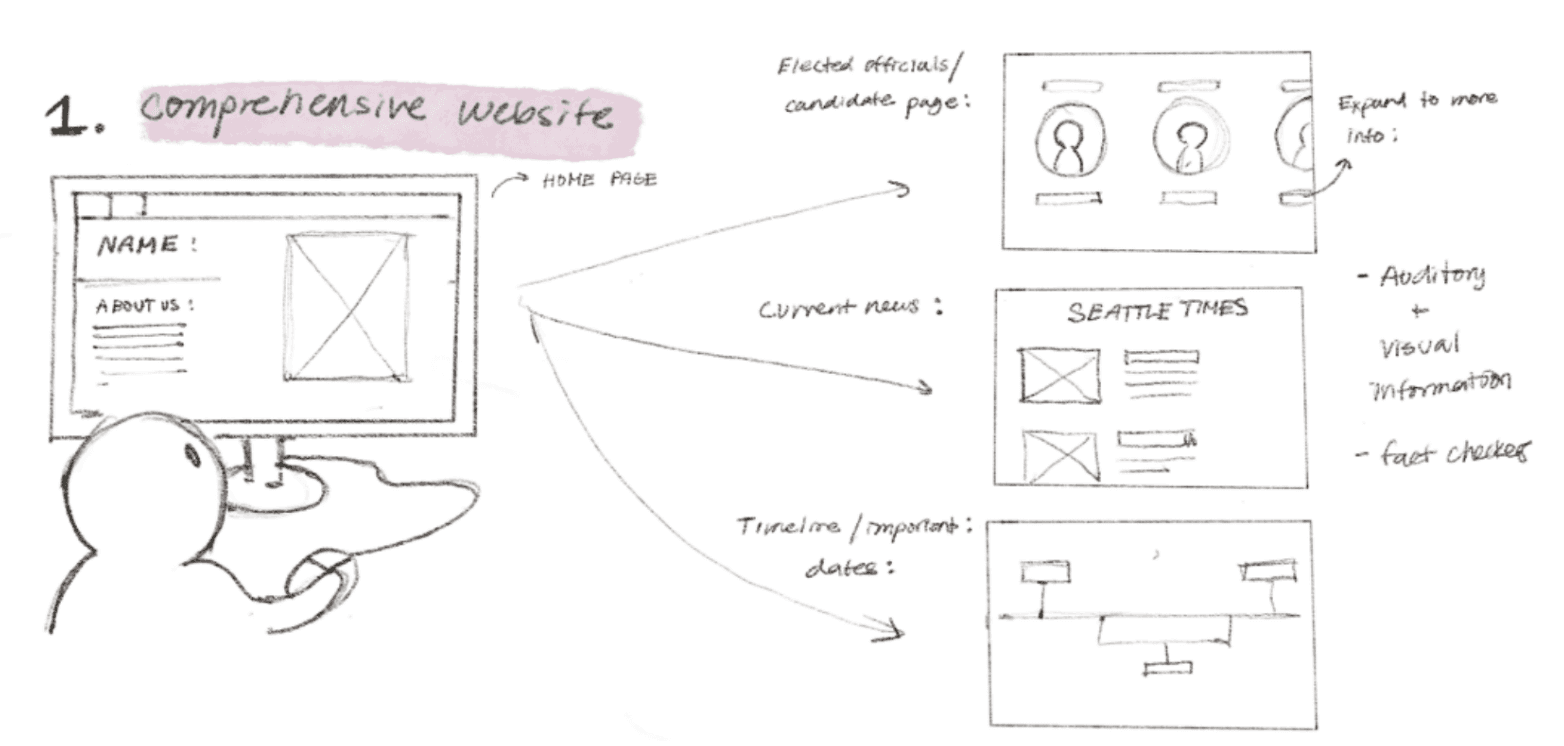
To begin the ideation process, we created some concept sketches based on some of the ideas we had discussed. Each of these concepts were based on experiences mentioned by participants in the interviews.
-Auditory & Visual Information
-Fact Checker
Timeline/important dates:
Elected officials/candidate page:
Current news:
HOME PAGE
Expand to more info

Possible Features:
Calendar to show important dates / expand info more
fairly stationary
separate from phone/tablet
similar to kindle...for news
We decided on a daily word game, similar to the New York Times daily games, but related to local politics. With a daily word game, users would have the opportunity to learn about politics in a quicker, less stressful way. The game could also encourage friendly competition between users and conversations between friends.

Storyboard
Then, we considered a possible use-case scenario with a storyboard. This storyboard explores the journey of our persona Emily who is looking to be more informed on local politics. Additionally, they want a resource that is engaging and something that they incorporate into their daily life.

Emily overhears her friends competing over a game and discussing the related local news.
She tries the game for herself and finds that it’s a daily word puzzle themed around Seattle current news and political information.
She enjoys the game and it becomes part of her daily routine. It inspires her to read news she never previously heard about.
She is now able to compete with her friends on the game and to join discussions about local news.
Information Architecture
The information architecture for the app includes 4 critical pathways:
The levels/rewards page, where the user can claim a coffee shop coupon and view their past coupons.
Answering the daily question question
Looking through the archives - sorting through old quizzes by date and topic, viewing favorites
Sharing stats and daily question with friends
Home Page: Rewards/Levels
Archive
Share
Settings
Points/Streak Status
Favorites
Calendar of quizzes
Past coffee shop coupons
Play/Answer question
Correct/
Incorrect
Fun Facts
Stats
Navigation Bar
Additional relevant topics
Mood Board
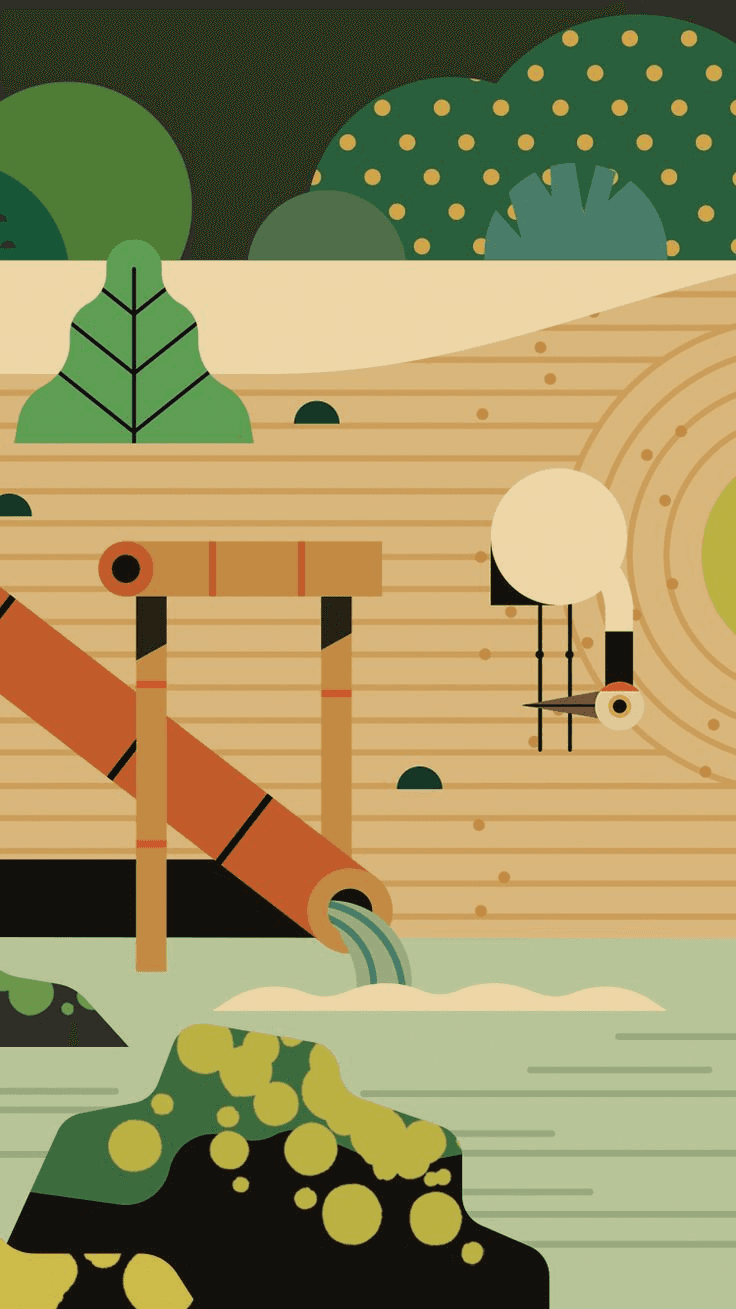
When creating our mood board, we thought of simple UI game design, calm muted colors (specifically blues and greens), and the connection to Seattle local politics. To connect our design to Seattle, we chose to incorporate an important Seattle symbol as a theme: coffee.







UI Style
When choosing the color scheme, wordmark, and typography, our goal was to create branding that is approachable, relaxing. To accomplish this goal, we created out wordmark, icons, buttons, and cards to have rounded edges. In regard to branding, we chose to center our app around coffee, to connect to Seattle and to emphasize that the quiz can be part of a daily routine. In addition, we wanted to make learning about politics more digestible. I designed each of these icons around the colors, components, and the wordmark typeface.
Primary Button
Heading 1 : Fredoka One
Body Text for content : Circular Std
Icons:
Colors:
Inactive Button
Local Elections & Government
What is typically the largest category of spending in King County's budget?
Share
Secondary Button
Pressed Button
Research
Competitive Analysis
In order to better understand the resources that exist within our identified problem space we completed competitive analysis of four different political products: Ground News, ClearVote, Allsides, and Moxy.


Pros:
Data privacy
Source comparison through bias ratings
Cons:
Premium subscription needed for many features
Lack of clear accessibility features
Pros:
Includes valuable information local elections
Cons:
Lacking visual design
Little public awareness
Pros:
Promotes diverse perspectives
Transparent methodology
Cons:
Potential oversimplification
Pros:
Engaging format
Comprehensive information
Cons:
Paywall can be distracting and disengaging
User Interviews
Four 30-minute interviews
Questions about the way participants normally engage in national politics and in local politics
Recruitment: Each member asked friends who attend UW to participate in the study. We each exchanged our participants’ information, so they could interview with a group member they had not met yet.
Inclusion criteria: UW students, 18 to 22 years old, Washington residents - they can participate in local politics.
Interview Findings
Through affinity mapping we were able to identify main takeaways from our interview data:
Participants encountered significantly more information about national politics than local politics.
Majority of participants felt that what they see about national and local politics is biased or opinionated.
Most of our participants get the information about politics from their family members and/or peers.
Variance in how participants would like to further engage in local politics and politics in general - conversations and community events or digital resources.
“It's kind of something that needs to be given to me. I will go on social media and I'll get all this information about national politics when I open it. But nothing about local politics”
“Yeah, it's really hard to feel like I'm finding the right information sometimes because I feel like a lot of articles, and like even people in person, like things are very opinionated.”
“...it's hard to kind of find … the direct source of like information, and what is actually factual”
“We talk a lot of politics, but I feel like we should also be giving back to the community. Go to the library, go, help out somewhere and go volunteer like stuff like that”
“...I also have a lot of family and friends who just go out and do the same thing. So I feel like it's… almost like a groupthink type of thing…my friends and I are filling out our ballots, and then we mail it in together”
“This is the 1st time I've ever voted in this last election. And so, even prior to this, it's always been a huge thing for me, because a lot of my family is directly impacted by it… so that kind of brings me to go out and vote for people”
Design Goals
Should be connected to reputable sources. This will allow users to feel more equipped when making decisions related to local politics (autonomy/trust)
Should be educational, accessible, and motivational, allowing users to engage with politics in creative and exciting ways
Encourages participation in local political discourse and activities by communicating how local politics impacts users
Design Requirements
Connect users with opportunities for political engagement such as community events, political organizations, or informational sources.
Provide information in different formats (visual, auditory, and textual) to improve accessibility for different users.
Provide unique and exciting ways to learn about political concepts and information.
Context
As a team of 4 designers in our HCDE 302/303 Fundamentals course, we were met with the task to design a product to help preserve democracy.
Problem
While there is a constant spread of content about national politics, information about local politics can be harder to access. Students may not have the time to search for information about local politics. In addition, they may feel unaware about the impacts of local political issues and policies on themselves and their friends and family. This may prevent them from learning more or having discussions with peers, as local politics are less prevalent in their daily life.
1 Question: How might we help support King County voters at UW, ages 18 - 22, to understand and engage in local politics?
Civic engagement in local politics is often overshadowed by national news but is equally important in strengthening Democracy.
Simone Chadha,
Pimnipa Thawai,
Lena Trieu,
Anwyn Yeats
UX Researcher, UX/UI Designer
20 weeks
January 2025 - June 2025
Figma,
Procreate,
Miro,
Google Docs
Team
Duration
Tools
My Role
Keeping young King County voters updated and involved with local politics one Sip. at a time.
